
Lazy chatbots make people dumb
Doctors using AI detect 20% fewer tumors after 3 months without it. Research reveals how AI assistance systematically erodes professional competence.

AI deskilling paradox and why Chat-Bots makes you dumber
It sounds like a bad joke: the technology meant to make professionals more productive is actually making them less competent. Yet this is exactly what scientific research in 2025 demonstrates. Doctors who work with AI assistance for three months detect significantly fewer tumors when the technology fails. Knowledge workers who rely on ChatGPT for daily tasks show measurably reduced critical thinking ability. The promise of artificial intelligence as an amplifier of human capabilities is turning into its opposite.
The irony is almost too perfect to believe. Billions are being invested in AI systems designed to make people smarter, faster, and more effective. Microsoft, Google, and OpenAI sell their products as augmentation tools, aids that expand human potential. What they don’t mention is that their systems are optimized for efficiency, not quality. The result is a vicious cycle in which users become increasingly dependent on technology that makes them progressively less capable.
The Core of the Signal
Lazy chatbots are not a quirky side effect of new tools, they are the visible symptom of a deeper automation shift that quietly hollows out expertise. The AI deskilling paradox matters now because generative assistants are sliding into everyday workflows faster than training can adapt, turning search boxes, dashboards and medical consoles into subtle engines of complacency. Once those patterns are normal, reversing the loss of independent judgment becomes slower, costlier and politically harder.
- Strengthen critical thinking by treating generative AI output as a rough sketch, never a finished verdict.
- Design training loops where juniors solve high stakes cases before checking chatbot answers, not the other way around.
- Monitor error patterns by asking how AI productivity tools reshape learning curves, search behavior and decision quality.
Measurable competence loss among medical professionals
A study published in The Lancet Gastroenterology & Hepatology examined nineteen experienced endoscopists across four Polish hospitals [1]. These physicians, each with more than two thousand colonoscopies to their name, gained access to AI assistance for polyp detection starting in late 2021. The researchers compared their performance in procedures without AI, both before and after the technology’s introduction.
The results were sobering. The average adenoma detection rate, a crucial indicator for cancer prevention, dropped from 28.4 percent to 22.4 percent when doctors worked without AI after months of AI use. A relative decline of twenty percent in just three months. Dr. Krzysztof Budzyń, lead researcher, concluded that routine AI exposure significantly reduces clinicians’ ability to independently identify precancerous growths. Prof. Yuichi Mori of the University of Oslo pointed to a fundamental methodological problem: earlier randomized studies that favorably compared AI-assisted colonoscopy with standard procedures may have used a control group whose skills had already been compromised by AI exposure.
This phenomenon is not some abstract theoretical concern. Every missed adenoma increases the risk of colorectal cancer, the third most common cancer worldwide. Earlier meta-analyses showed that every percentage point increase in adenoma detection rate correlates with a three percent decrease in interval cancer risk. The six percentage point decline documented in the Polish study therefore represents a substantial increased health risk for patients treated by AI-habituated doctors when the technology is unavailable.
Paradoxically, AI-assisted procedures still performed better than the degraded non-assisted procedures, creating a perverse incentive to never switch off the technology again. The physician becomes hostage to the dependency the tool itself created. Dr. Omer Ahmad of University College London warned in a commentary on the study that these findings temper the current enthusiasm for rapid adoption of AI-based technologies and underscore the importance of careful consideration of potential unintended consequences.
Why language models are inherently lazy
The explanation for this competence loss lies partly in how large language models function. Researchers from OpenAI and Georgia Tech published an analysis showing that LLMs are rewarded for confident guessing rather than expressing uncertainty [2]. The benchmarks used to train and evaluate these models penalize honest answers like “I don’t know” just as harshly as completely wrong answers.
This mechanism has fundamental consequences for the output users receive. A model that always provides an answer, even when wrong, scores higher on standard evaluations than a more cautious system that admits uncertainty. The researchers describe this as an epidemic of overconfidence. Language models systematically bluff because bluffing pays off within their training system.
For users, this means AI output almost always sounds confident, regardless of actual reliability. A junior employee asking for help with a complex analysis receives a fluently formulated response bearing all the hallmarks of expertise, but which may be fundamentally incorrect. The surface quality masks the underlying limitations. After repeated exposure to this seemingly competent output, users begin to distrust their own judgment.
The researchers argue that this problem cannot be solved simply by adding new evaluations. They advocate for adapting mainstream benchmarks to incorporate confidence targets. Models should explicitly learn that uncertain answers are acceptable and even desirable in certain situations. Without such reforms, hallucinations will remain a built-in feature of AI systems, regardless of technical improvements in architecture or depleting training scale. Current innovation in AI is fundamentally aimed at maximizing apparent competence, not at honestly communicating limitations.
The Microsoft research on critical thinking
A 2025 study by Microsoft Research and Carnegie Mellon University documented this effect among 319 knowledge workers [3]. The researchers collected 936 examples of AI use in work tasks and analyzed the relationship between trust in AI and critical thinking ability. The results confirmed a troubling pattern: the more trust employees placed in generative AI’s capabilities, the less critically they thought about the output.
The surveyed knowledge workers used generative AI at least weekly and provided 936 examples of how they deployed AI for work, ranging from looking up facts to summarizing texts. They primarily applied critical thinking when formulating clear prompts, refining queries, and verifying AI output against external sources. Six of the seven named researchers are affiliated with Microsoft Research, the research subsidiary of Microsoft founded in 1991.
The inverse relationship also held true. Employees with high confidence in their own skills actually displayed stronger critical thinking, despite the greater cognitive effort required. The difference lay not in capacity but in impact on behavior. AI reduced the perceived need to think for oneself. Participants reported that routine low-stakes tasks, such as proofreading or information gathering, were almost automatically outsourced to AI without further review.
Researchers also discovered what they termed mechanized convergence. Users with access to generative AI tools produced a less diverse set of outcomes for the same task compared to users without AI. This suggests that AI not only damages individual skills but also reduces the collective variety of ideas within organizations. When everyone uses the same tools with similar prompts, results converge toward an average that lacks originality.
The researchers warned that this habit may extend to higher-stakes tasks. Cognitive skills atrophy when not regularly exercised. A professional who only activates critical thinking for explicit crisis situations gradually loses the ability to identify subtle problems before they escalate. The distinction between routine and important blurs when the default mode becomes passive acceptance.
The automation paradox from 1983
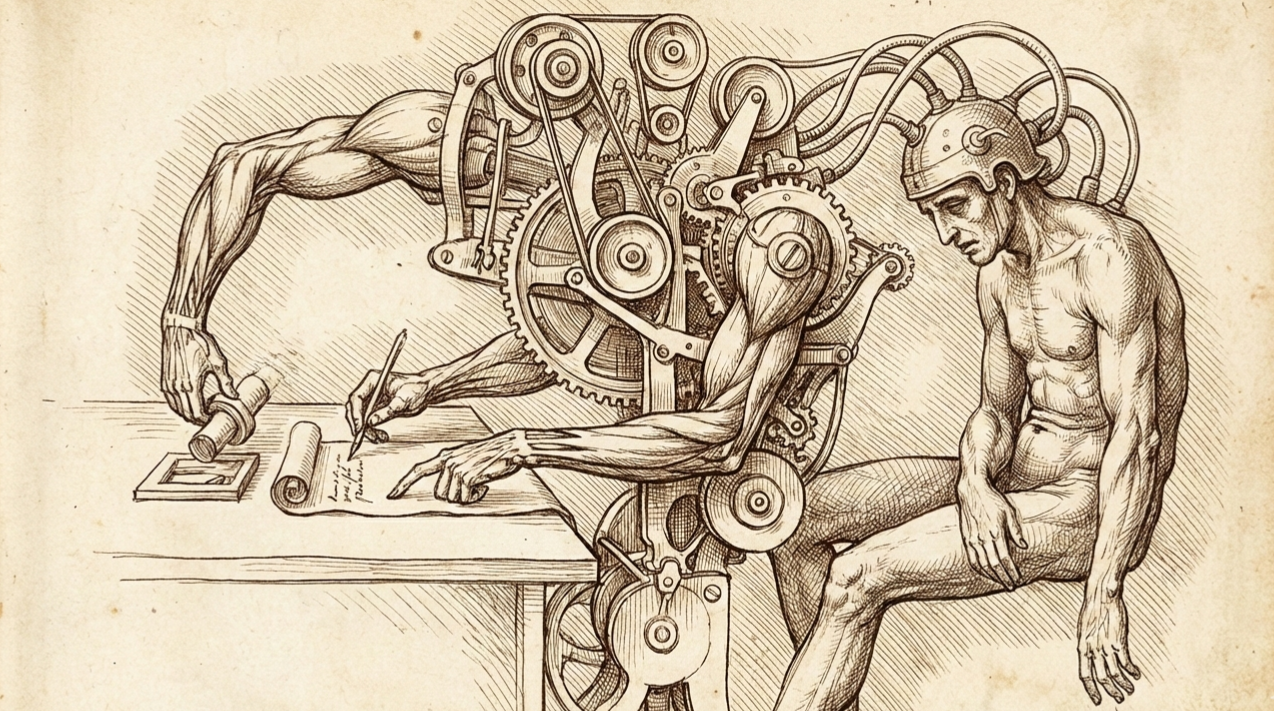
This phenomenon is nothing new. In 1983, cognitive psychologist Lisanne Bainbridge published her influential paper “Ironies of Automation” in the journal Automatica [4]. She described how automation of industrial processes paradoxically exacerbates human problems rather than eliminating them. When machines take over most tasks but humans remain responsible for exceptions and failures, an impossible situation emerges. Her paper has since been cited more than 2,300 times and remains relevant to contemporary discussions about AI and work.
Bainbridge identified two core problems. First, operators lose their skills through lack of regular practice. “Efficient retrieval of knowledge from long-term memory is dependent on frequency of use,” she wrote. Knowledge that isn’t applied evaporates. Second, this type of expertise develops only through use and feedback on effectiveness. Theoretical instruction without practical application results in superficial understanding that is quickly forgotten.
“The classic aim of automation is to replace human manual control, planning and problem solving by automatic devices and computers,” Bainbridge wrote. But she pointed out that even highly automated systems need humans for supervision, adjustment, maintenance, expansion, and improvement. The paradoxical conclusion: automated systems are still human-machine systems for which both technical and human factors matter. The ethics of system design requires acknowledgment of this fundamental tension.
The parallel with contemporary AI systems is striking. A pilot who flies on autopilot for years loses the manual flying skills that are crucial when systems fail. A radiologist who follows AI suggestions daily loses the pattern recognition necessary when AI misses a rare abnormality. The technology solves the problem for which the human was initially trained, after which the human is no longer able to solve the problem without the technology.
Structural deskilling as a systemic problem
Janet Frances Rafner, researcher at Aarhus University, places this phenomenon in broader perspective. “If left unchecked, deskilling can erode the expertise of individuals and the capacity of organizations,” she states in an interview with Communications of the ACM [5]. Her colleague Jacob F. Sherson, director of the Center for Hybrid Intelligence, adds that “deskilling and any fallout will only be visible in hindsight.” The effects are cumulative and delayed, making early warning signs easy to ignore.
Recent academic literature characterizes AI-induced deskilling as a structural problem, not individual failure. Researchers introduce the concept of capacity-hostile environments: environments in which AI mediation systematically impedes the development of human capabilities. This goes beyond personal responsibility toward systemic AI constraints. When the standard work environment continuously offers AI assistance, cultivating one’s own expertise is actively discouraged by the context itself. Organizations deploying autonomous agents face governance challenges as human oversight erodes alongside decision-making authority.
This explains why attempts at behavioral change at the individual level rarely succeed. An employee who decides to rely less on AI operates against the current of deadlines, productivity metrics, and collegial norms. The rational choice within the existing system is to maximize AI use. The irrational long-term consequence, competence loss, is neither measured nor valued by the system.
The circle of dependency
The pattern emerging is disturbingly consistent. A professional begins using AI for routine tasks and experiences immediate time savings. The AI produces output that appears superficially competent, usability is, after all, a design priority. The professional accepts this output as a starting point and spends less time on their own analysis. After repeated cycles, the ability to assess quality independently diminishes. The professional becomes dependent on the same system that caused the dependency.
Big Tech has little incentive to address this problem. The productivity narrative, AI enhances human capabilities, is central to their marketing and valuation. Deskilling undermines the argument for further AI adoption. Long-term consequences for human capital don’t fit into quarterly reports. Microsoft invests eighty billion dollars in AI infrastructure while its own researchers warn about cognitive decline among users of its products. Meanwhile, AI quietly reshapes organizational decision-making before leadership recognizes the shift in authority.
The situation is worsened by what researchers call mechanized convergence. When more professionals use the same AI tools for similar tasks, outputs become increasingly uniform. Creativity and diversity in problem-solving decline. A marketing team that collectively uses ChatGPT for brainstorming sessions produces variations on the same AI-generated concept rather than fundamentally different human perspectives.
Legal and educational warnings
The phenomenon is not limited to the medical sector. Law professors at the Illinois Law School concluded that students who used chatbots and other forms of generative AI were more susceptible to critical errors [5]. “Without proper checks and balances, the technology can lead to widespread deskilling,” they warned. Today’s students become tomorrow’s lawyers, judges, and legislators.
In education, research shows that AI tutoring has paradoxical effects. Students who used AI for math exercises performed better during practice sessions but worse during tests. The immediate aid impeded the deeper learning processes necessary for lasting knowledge acquisition. Neurological research confirms that writing an essay with one’s own brain produces a fundamentally different activation pattern than using ChatGPT, resulting in deeper understanding.
The implications for professional training are profound. How do you train a doctor to make diagnoses when AI systems have already made the diagnosis before the doctor sees the patient? How do you develop legal judgment when AI analyzes precedents faster than any student can read? The traditional learning cycle of attempt, error, and correction is disrupted when AI eliminates the margin for error by providing the answer in advance.
What this means for your expertise
The question is not whether AI causes deskilling, but how quickly and how deeply. The current generation of senior professionals was trained in a pre-AI environment and carries expertise that AI cannot replicate. But juniors entering the workforce now are learning their trade in an environment where AI assistance is the norm. In a decade, collective expertise in many professional fields will be fundamentally differently structured, possibly less robust.
This is not a call for technology refusal. AI offers real and demonstrable benefits for productivity and accessibility. The point is that these benefits are not free. The price is paid in gradual competence loss that only becomes visible when the technology fails or becomes unavailable. A professional who understands this can make conscious choices about when to rely on AI and when not to.
Matt Beane, professor at the University of California Santa Barbara, observes that senior engineers and programmers often produce faster and better work with AI because it accelerates their existing productivity. But the same systems can sabotage younger workers who benefit from collaboration with human experts. The technology differentiates between those who already know something and those who still need to learn.
Treat AI as an assistant, not as an authority. Check output actively and consciously, not passively. Maintain skills you don’t use daily. The professionals who remain relevant in ten years will be those who preserved their independent thinking ability while strategically deploying technology. The rest will be replaced by cheaper labor entering the same standard automation prompts.
Related Signals – Supporting Evidence & Solutions
This cornerstone signal is powered by these five subsignals that drill deeper into specific manifestations and solutions:
-
Is AI Making Your Brain Lazy? Cognitive Dependency – The neurological mechanism of dependency and how cognitive offloading atrophies mental skills.
-
Your AI Assistant Manipulates Your Brain – The five psychological manipulation tactics (dopamine loops, intermittent reinforcement, synthetic empathy) that accelerate deskilling.
-
The Mental Impact of AI Chat Friends – Emotional dependency patterns that mirror and amplify professional deskilling through social isolation.
-
AI Dependency, build a personal usage plan – Practical frameworks (time slots, no-go zones, self-checks) to preserve independent judgment while using AI strategically.
-
AI Chatbots Explained: What They Are and How You Can Use Them – Educational foundation: how LLMs work, their limitations, and responsible integration patterns.
References
[1] Budzyń K, Romańczyk M, Kitala D, et al. Endoscopist deskilling risk after exposure to artificial intelligence in colonoscopy: a multicentre, observational study. Lancet Gastroenterol Hepatol. 2025;10(10):896-903. Available from: https://www.thelancet.com/journals/langas/article/PIIS2468-1253(25)00133-5/abstract
[2] Kalai AT, Nachum O, Zhang E, Vempala SS. Why Do Language Models Hallucinate? OpenAI Scientists Say LLMs Rewarded For Being Too Cocky. arXiv preprint. 2025. Available from: https://theaiinsider.tech/2025/09/06/why-do-language-models-hallucinate-openai-scientists-say-llms-rewarded-for-being-too-cocky/
[3] Lee HP, Sarkar A, Tankelevitch L, et al. The Impact of Generative AI on Critical Thinking: Self-Reported Reductions in Cognitive Effort and Confidence Effects From a Survey of Knowledge Workers. CHI ‘25 Proceedings. 2025. Available from: https://www.microsoft.com/en-us/research/publication/the-impact-of-generative-ai-on-critical-thinking-self-reported-reductions-in-cognitive-effort-and-confidence-effects-from-a-survey-of-knowledge-workers/
[4] Bainbridge L. Ironies of automation. Automatica. 1983;19(6):775-779. Available from: https://www.sciencedirect.com/science/article/abs/pii/0005109883900468
[5] Samuel S. The AI Deskilling Paradox. Communications of the ACM. November 2025. Available from: https://cacm.acm.org/news/the-ai-deskilling-paradox/